Work begins
Construction starts on the Grotenburg, the wooded height chosen for its prominent position.
01 / The monument · Detmold
The Hermannsdenkmal is hard to overlook. What it means takes a little more looking.
Meet the man behind the myth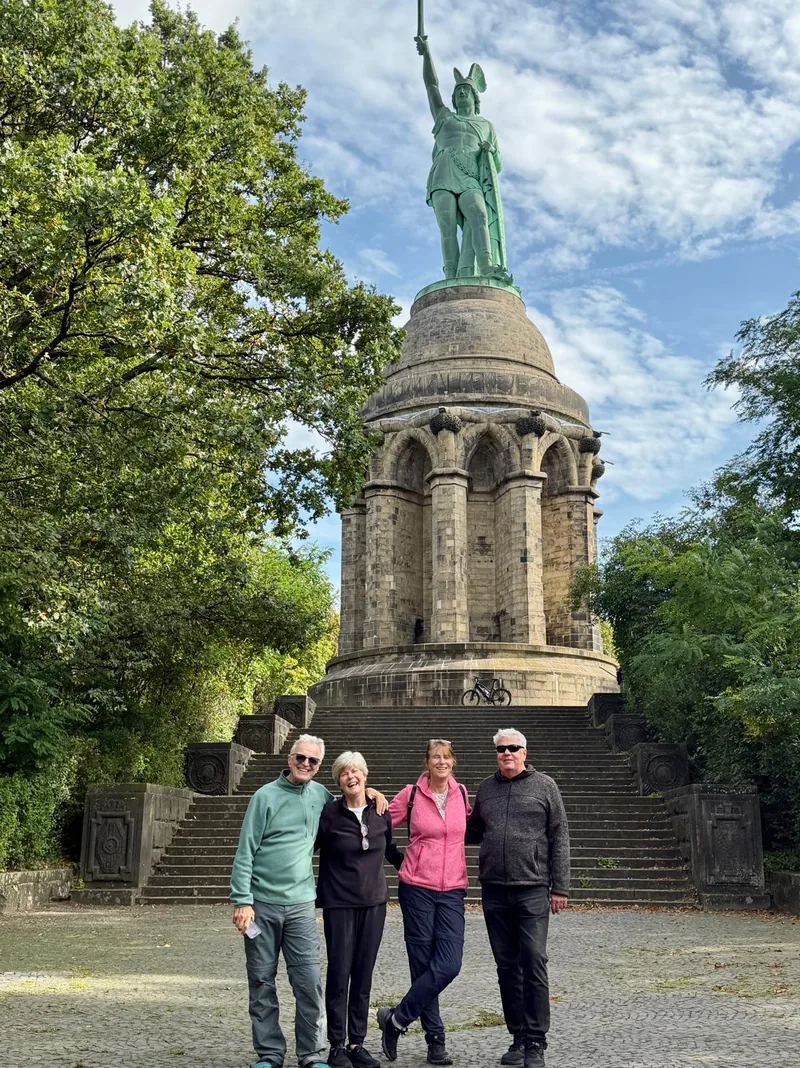
First, the person
Arminius came from a leading family of the Cherusci. Often described as a Cheruscan prince, he was also a man with direct experience of the Roman world: he served in Rome’s military, held Roman citizenship and attained equestrian rank.
In 9 CE, he helped bring together a coalition against Rome. Three legions under the governor Publius Quinctilius Varus were destroyed in the conflict remembered as the Varus Battle, or Battle of the Teutoburg Forest.
Our written accounts come from Roman authors. They offer valuable evidence, but also their own viewpoints. Arminius was an ancient political and military actor; treating him as a modern German national leader projects a much later idea into his world.
Then, the interpretation
The renewed circulation of ancient texts during the Renaissance brought Arminius back into European discussion. Tacitus’s Annals, published in a fuller edition in 1515, were especially influential. “Hermann” became a German reinterpretation of his name, not a securely documented birth name.
Later writers and political movements turned him into a symbol of resistance and national unity. In the 19th century, when a unified German state was still an aspiration, the story acquired particular force.
By the monument’s inauguration in 1875, the German Empire had been established. The ancient victor could now be presented as a predecessor of national unification. That tells us about the needs of the monument’s own time, as well as the event it commemorates.
An ancient person.
A later national myth.
A 19th-century monument.
The man who kept going
For the sculptor and architect Ernst von Bandel, this was a life’s project. Early ideas developed into a colossal figure with a stone base, a copper exterior and a difficult engineering problem inside.
Donations and supporters sustained the project, but money ran short. Bandel invested his own resources and worked through long interruptions. “Built in 37 years” does not mean 37 years of uninterrupted construction.
Construction starts on the Grotenburg, the wooded height chosen for its prominent position.
The pedestal is completed. Financial problems and disputes slow the larger project.
Preparations resume on the hill. Bandel returns and works towards mounting the great figure.
On 16 August, the finished monument is inaugurated with Emperor Wilhelm I present.
Look a little closer
Seven details. One very tall figure.
Select a numbered marker to explore.
The official figure height includes the raised sword, all the way to its tip.
Its inscriptions turn the weapon into a statement about German unity and national power.
A monumental shield rests at the figure’s side. Its scale is easy to miss from below.
The complete stone base, including its dome, accounts for roughly half the monument’s height.
The published overall height runs from the base to the sword tip.
Copper sheets form the outer figure; an internal iron framework carries it. The green surface is a patina.
The visitor viewing terrace belongs to the base. The statue itself is not a visitor observation room.
Schematic illustration, not to scale. Dimensions follow the monument operator’s published measurements. The figure measurement includes the sword.
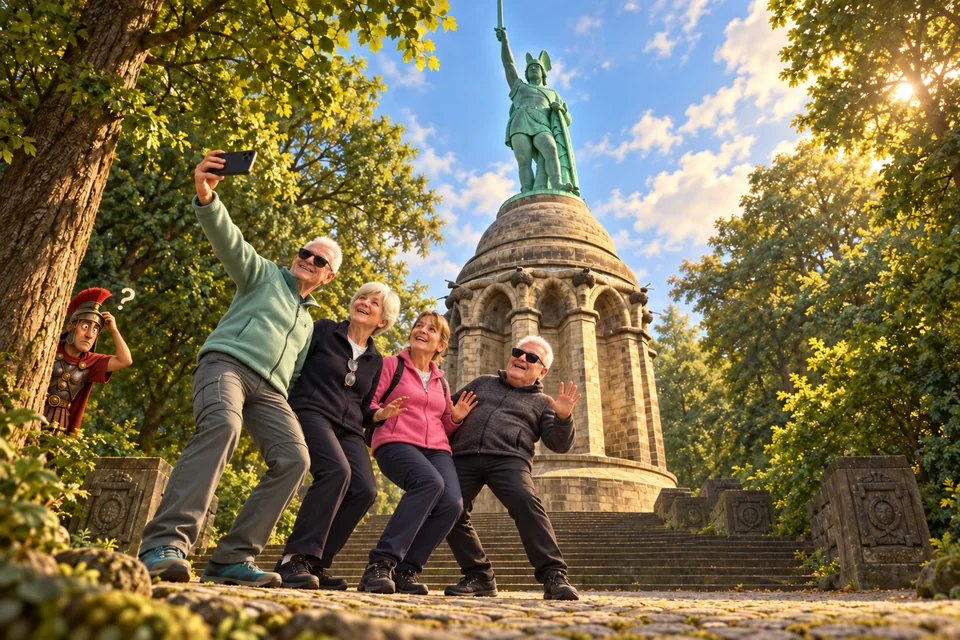
A brief historical inaccuracy
The Roman is imaginary. The problem of fitting the whole monument into one photograph is rather easier to believe.
Back to the actual photographsChecked on 18 September 2026. The sources differ on the ceremonial foundation-stone date; we use 1838 only for the documented start of construction. For dimensions, the current monument operator’s figures take precedence over inconsistent older summaries. Sources are mainly in German.