First, take a sea.
Sand accumulated in layers, then compacted and cemented into rock. The regional Osning sandstone formed during the Early Cretaceous; about 130 million years is a useful rounded reference for the Externsteine.
02 / The stones · Horn-Bad Meinberg
The Externsteine have been around for rather longer than our questions about them.
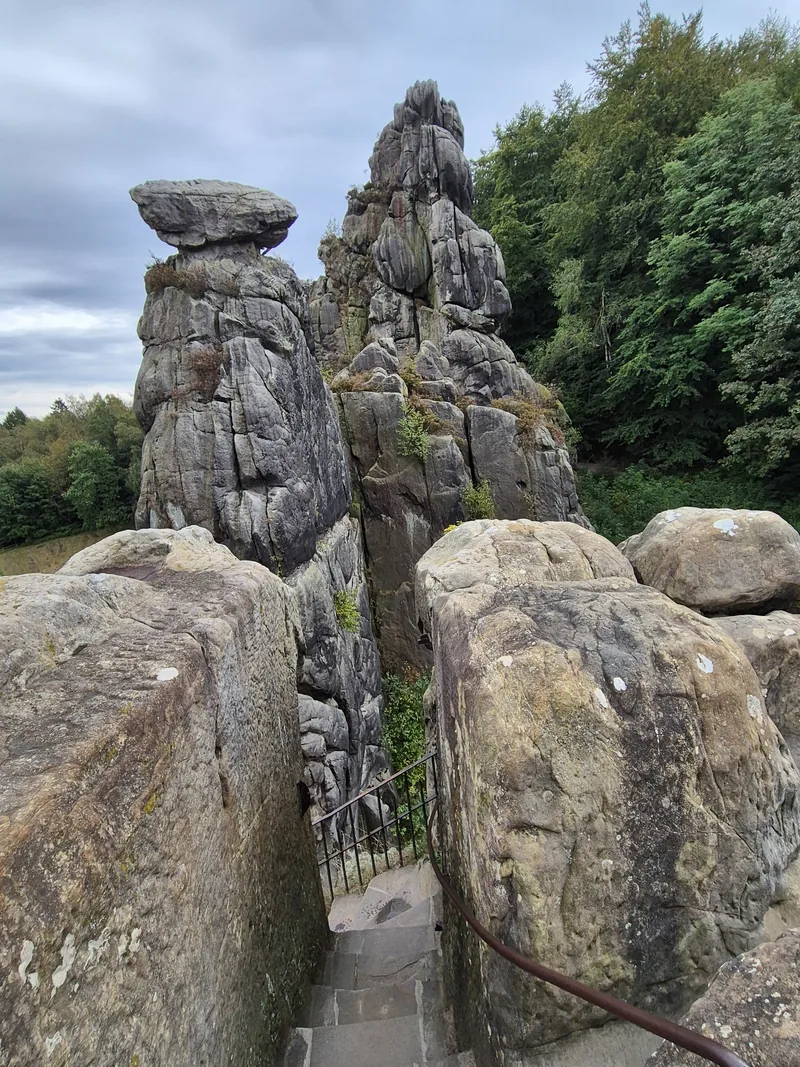
Geology does the heavy lifting
These are pillars of Osning sandstone. The material began as sandy deposits in a Cretaceous sea, around 130 million years ago. The freestanding towers we see today came much later.
A process sketch, not a reconstruction or a scale drawing.
Sand accumulated in layers, then compacted and cemented into rock. The regional Osning sandstone formed during the Early Cretaceous; about 130 million years is a useful rounded reference for the Externsteine.
Later movements of the Earth’s crust tilted the sandstone steeply upwards. Institutional summaries give different rounded dates for phases of this process, roughly 80–66 million years ago. It was not a single instantaneous event.
Water and weather attacked the fractured rock over millions of years. Softer or more exposed parts wore away; resistant pillars remained. Cracks, rounded surfaces and isolated towers are the visible results.
Nature made the rock. People left marks.
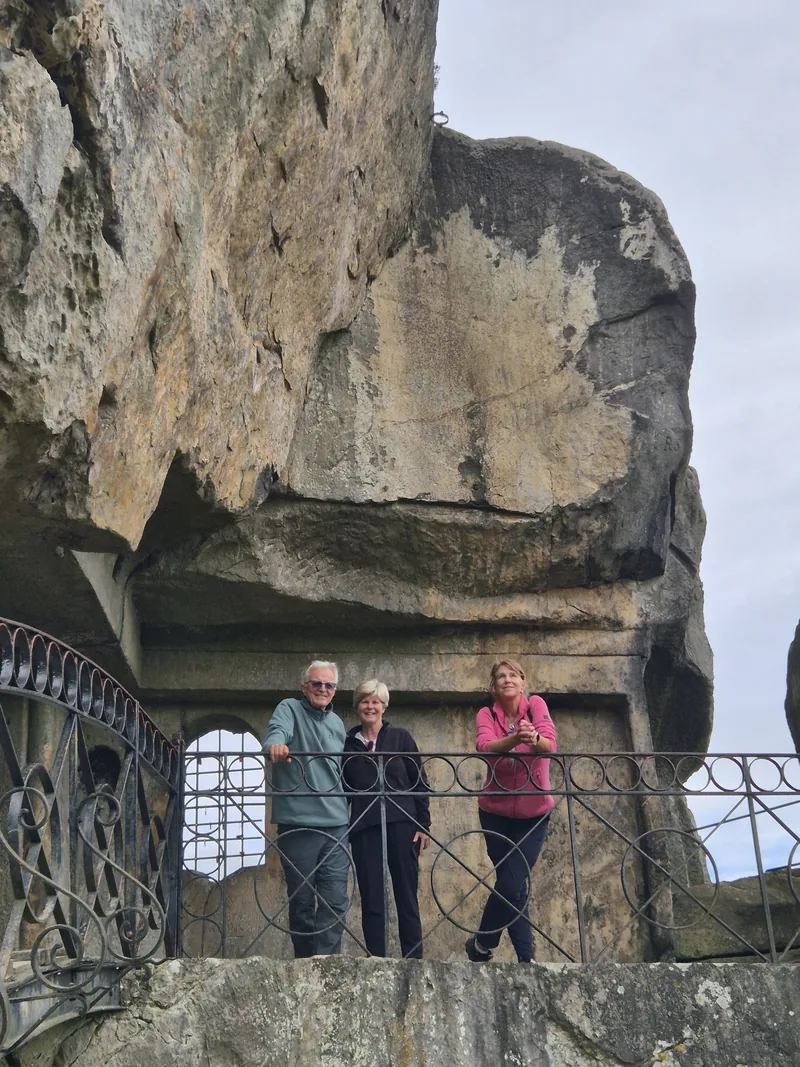
Our photograph · a landscape of natural rock and human interventions.
Flint tools show that prehistoric hunters were present in the surrounding area. That does not demonstrate continuous occupation, nor an ancient sanctuary. The gaps in the evidence matter.
Medieval pottery and metal finds indicate settlement between the 10th and 13th centuries. Later records describe a property belonging to the abbot of Werden, and hermits used the grotto complex in the later Middle Ages.
Carved directly into the rock, the relief shows Christ being taken down from the cross, with grieving figures beside him. Art historians generally place it in the 12th century. It is an important work of Romanesque Christian sculpture, not evidence for an earlier Germanic cult.
Artificial grottos, a rock-cut tomb and the upper chamber with its altar niche make human intervention unmistakable. Their individual dates and original purposes are not all settled.
The visitor stairway and viewing platform belong to the site’s later development. Renovations began under Princess Pauline in 1809; the pond was created around 1837. Today’s familiar scene also has a history.
Curiosity, with an evidence check
The rocks invite questions. The answers deserve labels. Open a claim to see what stands behind it.
In the 20th century, nationalist and Nazi interpretations also pressed the site into ideological service. Modern scholarship examines evidence, not the appeal of those stories.
Medieval finds, written records and Christian stonework establish human activity. The carved Deposition relief is a particularly clear surviving witness.
A widely favoured scholarly interpretation connects the chambers, rock tomb and other features with medieval representations of the holy sites of Jerusalem. That is an interpretation of the evidence, not a label preserved by the original builders.
The age and original function of individual worked features remain disputed. Dating fire traces can constrain the history of a chamber; it cannot settle every question about its creation or use.
No archaeological evidence establishes the popular claim that the Externsteine were a major Germanic or Celtic cult centre, or a prehistoric observatory. Repeating a claim does not supply the missing evidence.
Our camera. A little imagination.
The actual visit, beside a playful 3D retelling with our group. Slide between the two. The illustration borrows the people and the setting; it invents the scene.

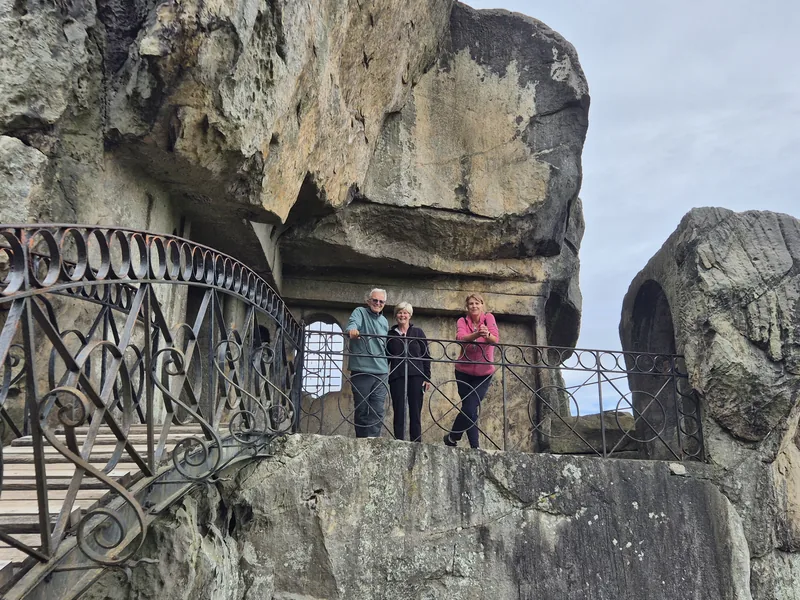
Different views of the same outing, not an exact reconstruction. The illustrated geological guide is a visual joke.
Checked on 18 September 2026. Geological figures are rounded: the Geological Survey gives 140–110 million years for regional sandstone deposition and about 66 million years for folding; the site operator gives about 130 and 80 million years. Another operator summary gives about 70 million years for uplift. We retain the distinction between deposition, tectonic phases and the later shaping of the towers. Sources are mainly in German.